Planer Graphs!
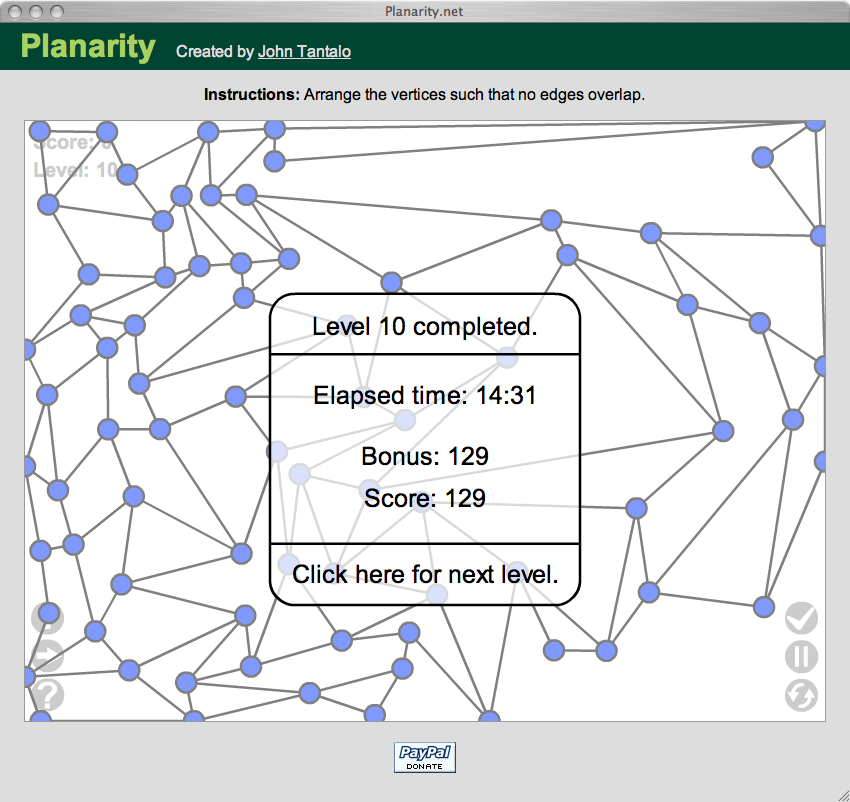
Who knew that Planer Graphs could be so much fun? I just stumbled across a game called Planarity where you start with a tightly laid out Planer Graph and move the edges so they don't cross one another. It starts out with small graphs and quickly increases the number of edges. The FAQ said if you could beat Level 10, you'd be in select company. Guess what?
Ahh, smell that? Rarefied air, friends.
Also, I think my final result puts me firmly in the 'messy thinker' camp.
I don't think that if I just started with Level 10 that I would have solved it. All of the tricks and intuitions you build up through the previous 9 levels aid greatly in figuring out the more difficult levels. Such as, looking for vertices that are obviously out of place and should be grouped with their neighbors or that moving lesser connected vertices (2 or 3) to the edges will give you more space to work with. I found levels 9 and 10 a cakewalk because level 8 took me almost a half-hour. Waiting for a furniture delivery, I had plenty of time.


![[Atom Enabled]](http://saladwithsteve.com/valid-atom.png)
2 Comments:
Neat. I've gotten up to level 9 so far. Gonna take a break before doing 10. :-)
On each level (at least the last few that I did) I noticed is that there would come a point where the flow of the game would suddenly shift from shuffling nodes around and not seeming to make much progress to suddenly everything falling into place. The last few minutes of solving a level would change the graph from an overlapping mess to being completely solved. So I've been trying to figure out how to get to that "tipping point" faster.
The one thing that bothers me about this game, and which bothers me about a number of other activities (including driving) is that I keep thinking "a computer should be doing this!"
10:41 AM
Hi Laurence, I have no doubt you'll be beating level 10 soon. There's a livejournal thread linked off the planarity site where people were talking about how they were solving levels over 20, you should give it a read!
I noticed the exact same shift in gameplay. The strategy I described above was the best I could come up with for making that tipping point come quicker. I noticed that I was solving the game in quadrants, and if you look at the graphic, the denser the points, the earlier I solved that quadrant. Once a quadrant was solved, I almost never touched it again.
And I agree that it's hard to forget that Mathematica would kick our butts at this game.
5:27 PM
Post a Comment
Links to this post:
Create a Link
<< Home